The High Renaissance more or less died with Michelangelo, and Mannerism (1520-1600) took its place. Following the death of the three greatest Renaissance artists—Leonardi da Vinci, Michelangelo, and Raphael—most artists more or less gave up on trying to top their predecessors. Instead, Mannerism was a movement to explore the individuality and idiosyncrasies of each individual artist. Some common themes of Mannerist art include asymmetry, dramatic lighting, dramatic use of color, prestezza, and an almost supernatural depiction of people.
The Deposition from the Cross, by Jacopo De Pontormo is an excellent example of this supernatural depiction of people. In this painting, everyone seems to be floating. Their toes barely touch the ground, and the people in the back of the painting are either (1) not touching the ground, or (2) they have really, really long legs.

Rosso Fiorentino (1494-1540) also painted Christ’s deposition from the cross. In his rendering, Rosso uses a very powerful use of dark lighting that makes the painting very dramatic.

Compare Rosso’s Mannerist painting style and use of lighting and color with Leonardo da Vinci’s Mona Lisa. Although it is also considered a classic, da Vinci’s work is far less dramatic and saturated with color. That is not necessarily a bad or good thing, but it is interesting to see the differences between the Mannerist and Renaissance use of color.
El Greco (1541-1614) was another Mannerist painter. One of his paintings depicts Jesus Christ purifying the Temple with a whip, driving out all the money changers. Once again, he uses far more color than his Renaissance predecessors.

El Greco, Rosso Fiorentino, Jacopo De Pontormo, and Tintoretto were just a few of the prominent artists during the Mannerist era, but they convey some of the common themes in that style of art, and how it differs from Renaissance art.
The Mannerist era was followed by the Baroque period. This era put greater attention to realistic detail and precision, similar to the Renaissance. But it also used more color than the Renaissance, like Mannerism. In a way, the Baroque period was a fusion of the two. If Renaissance art conveyed realism, and Mannerist art conveyed dramatism, then Baroque art conveyed dramatic realism.
For example, Caravaggio’s painting Calling of St. Matthew, which depicts Jesus Christ calling Matthew to be his disciple, has dramatic lighting, but it is also realistic in its depiction of people. Nobody floats or has ridiculously long legs.
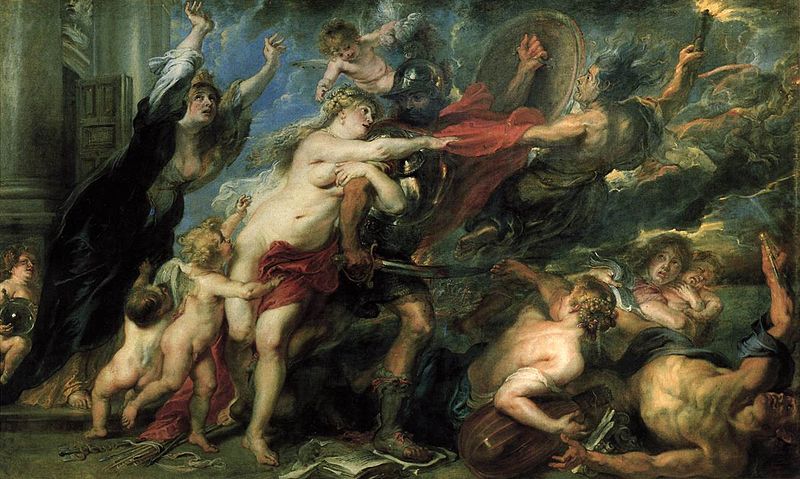
Another example is Peter Paul Ruben’s painting, Horros of Wars. This painting depicts Venus, the god of love, entreating Mars, the god of war, to stop his bloodshed. Rubens wrote the painting following the Thirty Years’ War, and the woman in the black who is clearly in distress symbolizes all of Europe at the time.
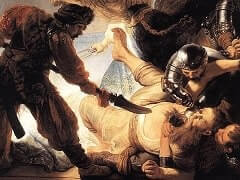
Finally, Rambardnt’s painting Blinding of Samson, graphically shows the Philistines gouging out Samson’s eyes, turning the horrors of the biblical story into a visual image.
 Asher Sisneros
I honestly find Horros of Wars profaine.
LikeLiked by 1 person
I can sympathize with that. While I sympathize with Rubens’ message—that war is destructive—I disapprove of his use of nudity and glorification of false gods.
LikeLiked by 1 person