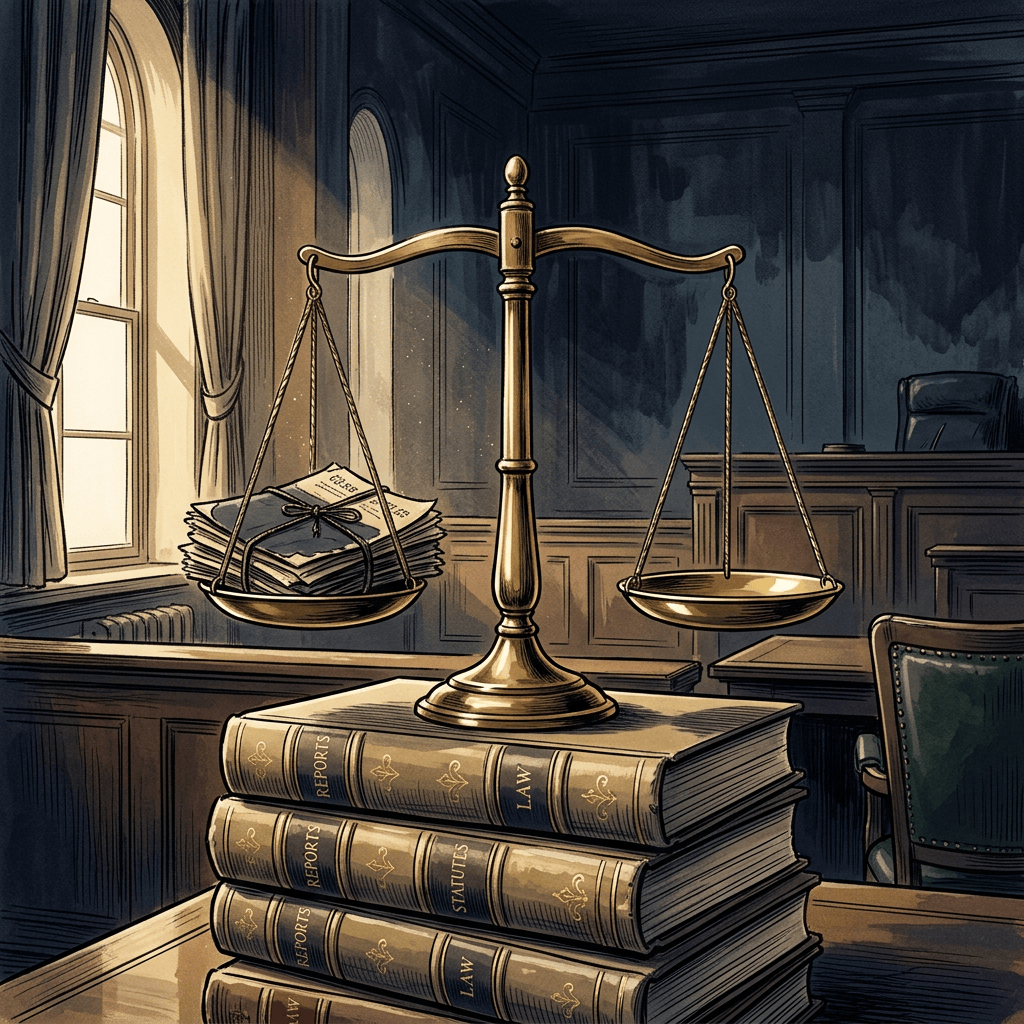
The Issue: Stare Decisis
The U.S. Supreme Court is very controversial today. Some people think we need a strong Supreme Court to maintain a horizontal separation of powers between the three federal branches of government. Others think a strong court creates a duopoly of power between the executive and judicial branches of government, which helps to undermine Congress, the very seat of power where the people sit through their representatives.
Anyone who attacks the judicial branch of government for becoming a de facto legislature should attack the legal doctrine of stare decisis. After all, that is the doctrine that obliges lower courts to follow precedent or, in other words, to rule consistently with their prior decisions and consistently with higher courts (Wex Definitions Team 2021). Without stare decisis, all of the courts are free to contradict each other and apply the law differently. And instead of using cases to formulate broad legal principles, they can only decide who is “right” in the cases in front of them. So, the question becomes, should the courts operate with stare decisis at all?
Kaufman: A Defense of Stare Decisis
Herbert Kaufman says yes, for the sake of legal continuity. How can people follow the law if it is constantly changing? In his exact words: “Law to be obeyed or followed, must be known; to be known it must be fixed” (Kaufman 1959). Clearly there needs to be continuity in what our property rights are and in how contracts are interpreted. Otherwise, if our understanding of how contracts work changes every day, those contracts will be useless.
But there is also an argument for the doctrine of stare decisis regarding the interpretation of the Constitution. Here’s the problem: if a judge disagrees with a prior interpretation of the Constitution and changes that interpretation in his decision, he has, in effect, rewritten our understanding of the Constitution (Kaufman 1959). To maintain a uniform understanding of the Constitution that does not change with the whims of each generation’s Supreme Court, Kaufman says that once the courts have an interpretation of the Constitution, they should not change that interpretation. Any change in that interpretation should come from a Constitutional amendment or from the legislature (Kaufman 1959). To Kaufman, in American democratic society, laws should be a reflection of the “beliefs of the people,” (1959) and the people can make their beliefs known through the legislature. Meanwhile, the courts should protect those beliefs like a referee.
Now to be clear, Kaufman is not against the courts making interpretations about the law, whether that is statutory law or Constitutional law. In some situations, where the law is unclear, he says courts will need to interpret that law. But Kaufman is against rewriting those interpretations over and over again. He says the courts should stick with one interpretation, and if that interpretation is contrary to the intent behind, or letter of, the law—then the people can make that clear through the legislative branch of government or through a Constitutional amendment.
Lash: When To Ignore Stare Decisis
Kurt Lash, on the other hand, has a more nuanced opinion. He says it often seems like the Supreme Court applies stare decisis sporadically—but he says they are not actually being hypocritical or inconsistent; they are, through a normative theory, weighing the costs of “maintaining judicial error” (2014). It is a given that courts will inevitably err. Even if they have all of the right intentions and scrutinize an issue exhaustively, sometimes they will make mistakes. So precedent can be erroneous. The question is, in the name of stare decisis, should that erroneous precedent stand?
Lash says that it depends. The problem is that if the courts completely ignore stare decisis and each Supreme Court era overrules the last one, there will never be continuity in the legal system. But if they strictly enforce stare decisis, the law may be built on erroneous precedent. To Lash, whether they should apply stare decisis or not depends on how high the cost of that error is (2014).
To weigh the costs of applying stare decisis, Lash presupposes that popular sovereignty is the basis of American governance. It all starts with the presupposition that authority comes from the people. From there, he says there are degrees of popular consent. For example, the highest law comes from the Constitution and from its amendment process. That is because the amendment process requires a supermajority support from the people: two-thirds of support in the House and Senate and support in three-quarters of the state legislatures, which is a very high bar of consent. Just like the amendment process, statutes have a bar of consent because they must be passed by both chambers of Congress—but that bar is not nearly as high. Majority support can pass a statute in Congress, but only supermajority support can pass a constitutional amendment. So Lash says that although statutes have authority as the will of the people, the Constitution and its amendments have a thicker supermajoritarian support, which gives them a higher authority, and that is why congressional statutes that violate the Constitution can be overruled (2014).
In terms of popular sovereignty, Lash says there are “two dimensions” to evaluate the cost of judicial errors (2014). The first dimension is the cost of intervention versus nonintervention. In other words, is the problem with a judicial precedent that the courts intervened when they shouldn’t have or that they refused to intervene when it was their duty? Lash says that, of the two errors, it is more costly for the courts to intervene when they shouldn’t because, in situations like that, there is always the possibility for a democratic remedy by the legislature. Meaning, even if the problem is that the legislature passes an unconstitutional statute, the legislature can always repeal that law in the future and remedy the problem democratically if courts do nothing (Lash 2014).
The second dimension is the cost of immunity from, versus allocation of, government control. A precedent that unconstitutionally messes up the allocation of power between the branches of government is costly. But a precedent that unconstitutionally strips a citizen’s “immunity” from governmental control in one area, i.e., strips away an individual right, is far more costly.
Thus, from Lash’s viewpoint, put together, the most costly mistake the courts can make is one that involves intervention and immunity, where they intervene and strip away an individual right. Lash says the courts should ignore stare decisis in a situation like that—when the cost of the erroneous precedent is very high, and they should remedy the error. But if the cost is low relative to the cost of the legal discontinuity that comes from changing legal precedent, then the courts should honor stare decisis and leave the erroneous precedent in place.
Conclusions on Stare Decisis
First and foremost, stare decisis has utility. There is no doubt about it. In that respect, Kaufman is absolutely right. If all judicial precedents are perfectly consistent, the law is much simpler to follow. It also makes it less likely for judges to pervert their authority and become quasi-legislators, who interpret the law based on what they think it should say, rather than on what it actually says.
Lash also has a point, though. Even though stare decisis is a good general principle, sometimes precedent is blatantly unconstitutional or poorly reasoned, and sometimes ignoring stare decisis may not be that big of a deal, while the costs of leaving that corrupt precedent in place are really high. So, in some cases, stare decisis should be ignored.
However, Lash is wrong when he says erroneous precedent should stand if the costs of overruling that precedent are high and the consequences of the error are low. Of course, because of the compounding effect of precedent, where one precedent helps inform how another precedent is formed, and so on and so forth, it makes sense to uphold erroneous precedent when the issues at stake are relatively trivial. Overruling precedent can be very messy, so it is practical to leave those trivial errors in place.
But justice is not always practical. If courts make mistakes about constitutional interpretation—as they certainly do—those erroneous interpretations have no authority as law.
References
Kaufman, H. C. (1959). A defense of stare decisis. Hastings Law Review, 10(3), 283–89.
Lash, K.T. (2014). The cost of judicial error: Stare decisis and the role of normative theory. Notre Dame Law Review 89(5), 2189–2218
Wex Definitions Team. (2021). Stare decisis. Legal Information Institute.






Leave a Reply