
Our attitudes about the world are one thing, and they can be remarkably strong. But reality is another thing, and it can be something very different. This happens because our attitudes are affected by far more than just reality. They are affected by things such as longstanding religious beliefs and historic cultural attitudes, individual friends and family, and Hollywood movies and mainstream news reports. Our minds just sit there, as our beliefs beg to be affected by all of these cultural influences. And that could not be more true regarding crime.
Anecdotally, in the last ten years, it seems like robbery rates have stayed the same in the United States. I do not think there are more or less robberies today, per capita, than there were in 2016. Now, to be clear, robbery is a specific kind of theft. Theft as a whole is taking something that does not belong to you. But robbery involves the endangerment of life. It involves the threat of violence. If a young middle schooler steals a pack of gum in a convenience store without anyone noticing, they have committed theft, but they have not committed robbery. I say this because robbery, as a subset of all forms of theft, seems like it would be a relatively uncommon crime.
I would imagine that, in the last decade, robbery peaked sometime during 2020 in the middle of COVID-19 and the BLM riots. That being said, as lives have returned back to normal, I am guessing that robbery has decreased in the nation and returned to its level ten years ago. And although my home state of Texas is more conservative and has policies that are tougher on crime than states like California or New York, because of my state’s large population, my guess is that Texas’s crime statistics move consistently with the nation as a whole.
The actual data, however, tells a different story. According to data reported by the Federal Bureau of Investigation (FBI), there were actually more robberies per hundred thousand people in 2016–2019 than there were in 2020 (Uniform Crime Reporting Program 2026). And, per capita, there were more robberies in 2020 than there are today, but my original suspicion that robbery peaked during the tumultuous year of 2020 is incorrect. The news may have sensationalized stories about robbery and violence at the time, but it was not abnormally high.
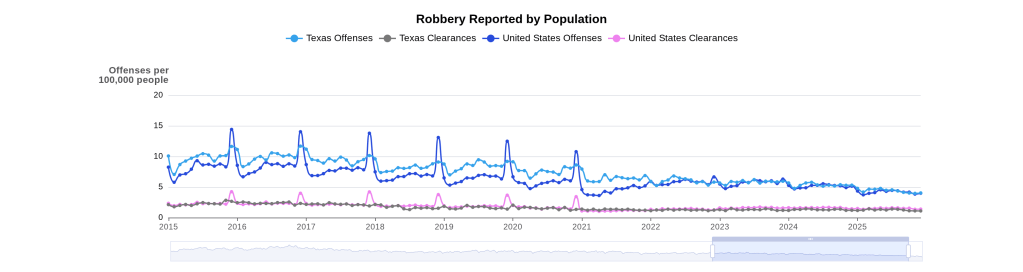
In terms of the overall trend, per capita, cases of robbery have declined over the past decade (FBI Uniform Crime Reporting Program 2026). The higher robbery rates of 2015–2020 dropped drastically in 2021, rose again from 2022–2024, and then began dropping again from 2024–2025. To put the overall decline in perspective, based on simple arithmetic, there were an average of 8.6 robberies every month per hundred thousand people in 2015, but that number dropped to 3.8 in 2025.1
A similar pattern followed robberies in Texas (FBI Uniform Crime Reporting Program 2026): 2015 and 2016 had the most robberies, but that number fell considerably over the next decade. For example, in 2015, there were an average of 9.8 robberies every month per hundred thousand people.2 Meanwhile, in 2025, that average dropped to 4.4. 3
There are a few conclusions based on the data reported by the FBI. First, Texas’s robbery trend is similar to the rest of the nation. This is unsurprising. Houston, Dallas-Ft. Worth, and San Antonio are massive metro areas. In general, where there are people, there is crime.
Second, contrary to my original suspicion, robbery per capita has dropped in the past decade. It did not stay the same. It fell considerably.
Third, for almost every single month in the last decade, Texas has maintained a slightly higher robbery rate per hundred thousand people than the national average. Originally, I thought this was surprising since Republican officials in Texas love to brand themselves as “tough on crime.” And even though they may very well be embellishing their own track record, given the population of Texas, it does make sense for our robbery rate to be slightly higher than the national average.
Fourth, there was no spike in the robbery rate during COVID-19 in either the national or state average. This is where the FBI’s data totally contradicted one of my original assumptions. I saw videos of riots; I read headlines of rampant crime. So where did all of the robbers go? There is no doubt that riots took place in some parts of the country. But perhaps the real extent of it was oversensationalized by the media. As someone who lives in a more rural area of Texas, a lot of people I know were petrified in 2020. They were not scared of the virus, necessarily. They were scared of other people. As just one example, one of my neighbors read reports about looting in places like San Francisco, and she stocked up on ammunition. But rioters never came to our city. And maybe, as the FBI’s data suggests, the extent of the threat was overblown by the news, or perhaps petty crime increased in insolation during 2020, without an increase in robbery.
Either way, even though I was correct that Texas’s robbery trend moved similarly with the rest of the nation, I falsely assumed that robbery increased in 2020, when it did not. Hopefully this demonstrates the power that comes from shaping people’s attitudes and also the danger that comes with falling prey to misleading influences. Cultural influences shape our beliefs, and our beliefs shape our actions. So carry this with weight.
Notes
- These averages are based on the data provided by the FBI. Averages were taken from the data set that covers robberies during the years 2015–2025. Here is the calculation for the 2015 average: (8.2+5.8+7.0+7.2+7.9+9.3+8.6+8.7+8.4+8.8+8.3+14.4) robberies/12 months =~ 8.6 robberies/month. Here is the calculation for the 2025 average: (4.3+3.7+4.0+4.1+4.5+4.3+4.5+4.4+4.2+3.8+4.0) robberies/12 months =~ 3.8 robberies/month.
↩︎ - This is based on the data from the FBI. Here is the calculation for Texas robbery offenses in 2015: (10.7+7.1+8.7+9.2+9.7+10.1+10.4+10.2+9.2+10.1+11.1+11.6) robberies/12 months =~ 9.8 robberies/month. ↩︎
- This is based on the data from the FBI. Here is the calculation for Texas robbery offenses in 2025: (4.8+4.1+4.7+4.6+4.8+4.5+4.5+4.4+4.1+4.0+4.0+4.0) robberies/12 months =~ 4.4 ↩︎
Reference
Federal Bureau of Investigation Uniform Crime Reporting Program. (2026, September.) Robbery reported by population. U.S. Department of Justice, Federal Bureau of Investigation. https://cde.ucr.cjis.gov/LATEST/webapp/#/pages/explorer/crime/crime-trend








Leave a Reply