Note: This paper was originally submitted to Professor Frank Demos at Thomas Edison State University on September 28, 2026, and then it was subsequently published here.
The Bad and the Beautiful (1951) is a film about the rise and fall of a young and ambitious Hollywood producer named Jonathan Shields. On his way to the top, he screws over three people: a director, an actress, and a writer. After these people become rich and famous, they reminisce about how Jonathan Shields took advantage of them and how he would do anything to make a good movie—no matter the cost. But even though they hate him, his brilliance and unyielding standards also turned them into who they are. In this way, the film shows some of the horrible costs of the studio system but also how it created the Hollywood people know today.
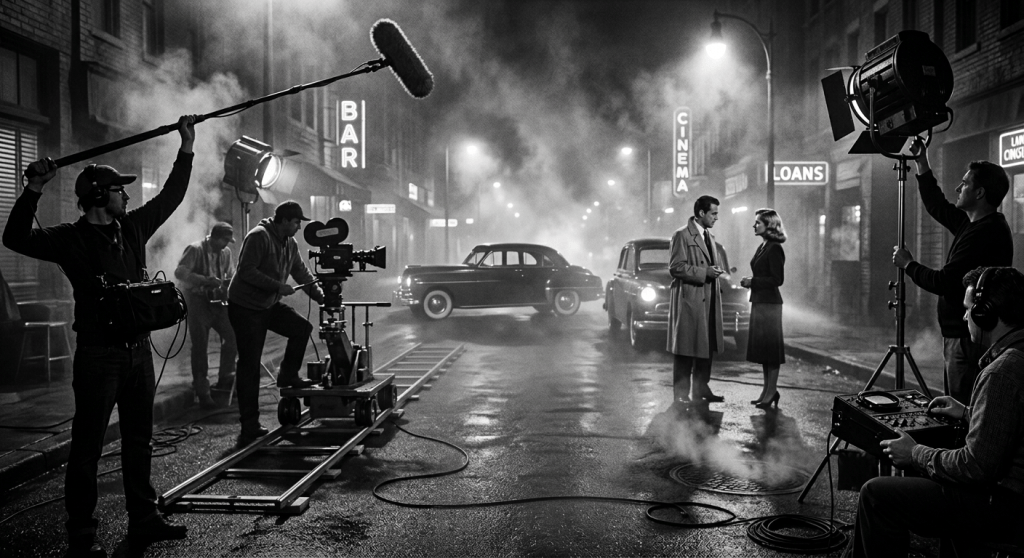
The biggest feature of the studio system was the central role producers played. They did not just approve movie concepts and write checks. They were involved in everything from the writing and casting to the directing and editing. In that way, in The Bad and the Beautiful, Jonathan Shields personified the quintessential producer of that era. When James Lee Bartlow wrote a screenplay, Jonathan Shields deleted lines and lines of dialogue and said, “[W]hat she’s feeling, we’ll leave for the audience to imagine. … They’ll imagine it better than any words you and I could ever write.” As the producer, he decided how the story would be told. Or, on another occasion, Georgia was acting in a scene, but her movement and behavior and tone did not convey the right message. So Shields gave her pointers. He told the actress how to act. Or, on a third occasion, the director Ellstein was shooting a scene, but the shot does not look the way Shields envisioned. Then he got in an argument with the director and directed the entire film himself. In this way, the film shows the crucial role producers played in the studio system and how they were involved in everything. The hands-on approach of producers under the studio system gave movies order, and the financial power of the studios gave filmmakers the means to hire hordes of actors, build massive sets, record from multiple angles, and add music scores—things that did not exist before the studio era.
The fundamental problem with the studio system is that because the studios were motivated by profits, producers viewed their creatives as tools, not as collaborators. For example, writers and actors often signed long-term contracts that gave them no control over which movies they worked on. The Bad and the Beautiful (1951) showed this to an extent when Shields brooded over losing Georgia as a star. He considered suing her in order to enforce the contract but decided not to. In real life, however, many producers were not so kind. Often, they were willing to sue, even internationally, in order to enforce their contracts with actors (Dirks n.d.), even if those contracts paid actors remarkably little money and worked them extremely hard. In The Bad and the Beautiful (1951), Jonathan Shields was willing to steal Fred Amiel’s screenplay, pretend that he loved Georgia when they were filming a movie, only to betray her love and sleep with another woman as soon as the filmmaking was over, and tell a handsome actor to sleep with James Lee Bartlow’s wife—because they were all just tools in his toolbelt. To him, hurting them is what he had to do to make great movies.
In other words, the studio system produced great movies, but that came at a cost. The system was motivated by profits, and that hurt a lot of the people involved in the movie-making process. Eventually, the courts intervened, and studio abuse came to an end (Sharman 2020). But the studio system still left an enduring legacy by showing people what filmmakers were capable of when resources were at their disposal.
References
Dirks, T. (n.d.) Film history of the 1920s: The pre-talkies and the silent era. Filmsite.
Sharman, R. L. (2020). Moving pictures: An introduction to cinema. University of Arkansas.



Leave a Reply